How many zeros are at the end of 50 ! when it is written out in full?
Explanation
 Adrien-Marie Legendre1752–1833 · Mathematician“A difference of squares is a product waiting to be seen.”
A trailing zero needs a factor 2 and a factor 5. Twos abound; fives are the bottleneck, so count fives.
⌊50/5⌋ = 10 — the multiples of 5.
⌊50/25⌋ = 2 — the multiples of 25 contribute a second five each (25 and 50).
⌊50/125⌋ = 0.
Total fives = 10 + 2 = 12.
There are far more twos (⌊50/2⌋ + ⌊50/4⌋ + … = 47), so twelve pairs form and 50! ends in exactly twelve zeros. Stopping at 10 forgets that 25 and 50 each carry two fives.
What are the last two digits of 7<sup>2024</sup>?
Explanation
 Carl Friedrich Gauss1777–1855 · Mathematician“Mathematics is the queen of the sciences, and number theory is the queen of mathematics.”
The last two digits are the residue modulo 100. Find the period.
72 = 49, 73 = 343 ≡ 43, 74 = 7 · 43 = 301 ≡ 1 (mod 100).
So 7 has order 4 modulo 100 and the residues cycle 7, 49, 43, 1.
Since 2024 = 4 · 506, the exponent is a multiple of 4, and
72024 = (74)506 ≡ 1 (mod 100).
The last two digits are 01 — the leading zero matters, since we were asked for two digits.
Euler’s theorem promises only 7φ(100) = 740 ≡ 1; the true order 4 divides 40, as it must, and finding it saves ten-fold work.
A triangle has sides of lengths 5, 6 and 7. What is its area?
Explanation
 Archimedes of Syracusec. 287–212 BC · Mathematician & Engineer“Give me a place to stand, and I shall move the Earth.”
Three sides and no angle: this is Heron’s ground. Take the semiperimeter first.
s = (5 + 6 + 7)/2 = 9.
Area = √[s(s−a)(s−b)(s−c)] = √(9 · 4 · 3 · 2) = √216.
Simplify: 216 = 36 · 6, so the area is 6√6 ≈ 14.7.
A check by the law of cosines: cos of the angle between 5 and 6 is (25 + 36 − 49)/60 = 1/5, so its sine is √24/5, and the area is ½ · 5 · 6 · √24/5 = 3√24 = 6√6. ✓
Beware the right-triangle instinct: 5-6-7 is not right, since 25 + 36 ≠ 49. Treating it as such gives 15.
What is the value of the sum 1/(√1 + √2) + 1/(√2 + √3) + … + 1/(√99 + √100)?
Explanation
 Gottfried Wilhelm Leibniz1646–1716 · Mathematician & Philosopher“Nothing is more important than to see the sources of invention.”
See the source of the invention, not the invention. Each term hides a difference; rationalise it and the sum collapses.
Multiply the k-th term above and below by √(k+1) − √k:
1/(√k + √(k+1)) = (√(k+1) − √k) / [(√(k+1))2 − (√k)2] = √(k+1) − √k,
because the denominator is simply (k+1) − k = 1.
The sum therefore telescopes:
(√2 − √1) + (√3 − √2) + … + (√100 − √99) = √100 − √1.
Every intermediate root cancels against its neighbour, leaving 10 − 1 = 9.
The last term is the one with √100, so the sum has 99 terms — not 100. Miscounting the final index is the only way to lose this problem.
In how many ways can 10 identical balls be placed into 4 distinguishable boxes so that no box is empty?
Explanation
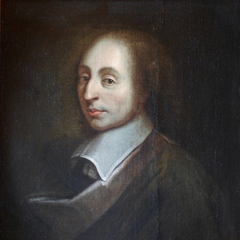 Blaise Pascal1623–1662 · Mathematician & Philosopher“Chance is tamed the moment we learn to count the ways.”
Lay the ten balls in a row. Nine gaps separate them. Choosing where to cut the row into four nonempty runs means choosing 3 of those 9 gaps — and the boxes, being distinguishable, receive the runs in order.
Number of ways = C(9, 3) = (9 · 8 · 7)/(3 · 2 · 1) = 84.
Equivalently, substitute xi = yi + 1 to absorb the “nonempty” condition; then y1 + … + y4 = 6 with yi ≥ 0, and the stars-and-bars count is C(6 + 3, 3) = C(9, 3) = 84.
Allowing empty boxes would give C(13, 3) = 286 — the distractor. The single word “nonempty” moves the answer by a factor of more than three.
What is the value of <em>x</em> that satisfies log<sub>2</sub>(<em>x</em>) + log<sub>2</sub>(<em>x</em> − 2) = 3?
Explanation
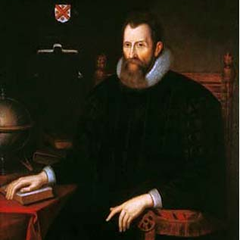 John Napier1550–1617 · Mathematician“Seeing there is nothing that is so troublesome as the multiplications and divisions.”
My logarithms turn multiplication into addition; read the equation backwards and the product reappears.
log2[x(x − 2)] = 3, so x(x − 2) = 23 = 8.
x2 − 2x − 8 = 0, that is (x − 4)(x + 2) = 0, giving x = 4 or x = −2.
Now the step that decides the problem: check the domain. A logarithm demands a positive argument. At x = −2 both log2(x) and log2(x − 2) are undefined. At x = 4 we have log24 + log22 = 2 + 1 = 3. ✓
The answer is 4. Combining logarithms can create solutions the original equation never had; every candidate must be returned to the equation it came from.
A triangle has sides of lengths 13, 14 and 15. What is the cosine of the angle opposite the side of length 14?
Explanation
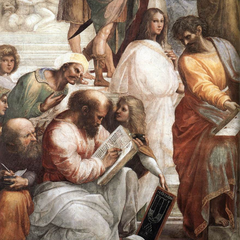 Pythagoras of Samosc. 570–495 BC · Mathematician & Philosopher“Number rules the universe.”
The law of cosines names the angle by the side that faces it. With b = 14 opposite the angle B, and the other two sides 13 and 15:
b2 = a2 + c2 − 2ac cos B.
196 = 169 + 225 − 2(13)(15) cos B = 394 − 390 cos B.
So 390 cos B = 198, and
cos B = 198/390 = 33/65.
Sanity: 33/65 ≈ 0.508, an angle just under 60° — plausible for the middle side of a 13-14-15 triangle, whose angles are all acute. The famous area 84 confirms the shape: sin B = 2 · 84/(13 · 15) = 56/65, and indeed (33/65)2 + (56/65)2 = (1089 + 3136)/4225 = 1.
The distractor 56/65 is that sine — the right ratio, the wrong function.
In triangle <em>ABC</em> the angle at <em>A</em> measures 60°, with <em>AB</em> = 8 and <em>AC</em> = 5. The bisector of angle <em>A</em> meets <em>BC</em> at <em>D</em>. What is the length <em>AD</em>?
Explanation
Pythagoras of Samosc. 570–495 BC · Mathematician & Philosopher“Number rules the universe.”Areas are the shortest road. The bisector cuts triangle ABC into ABD and ACD, and each of the three areas can be written with the sine formula.
Let t = AD. The bisector makes two angles of 30° at A.
[ABD] = ½ · 8 · t · sin 30°
[ACD] = ½ · 5 · t · sin 30°
[ABC] = ½ · 8 · 5 · sin 60°
The two pieces make the whole:
½t sin 30°(8 + 5) = ½ · 40 · sin 60°.
With sin 30° = 1/2 and sin 60° = √3/2:
t · (1/2) · 13 = 40 · (√3/2), so 13t = 40√3 and t = 40√3/13 ≈ 5.33.
The general formula follows the same way: AD = 2bc cos(A/2) / (b + c). Do not expect AD to be shorter than the shorter side: here it is 5.33, longer than AC = 5. Only an altitude is bounded by the sides it falls between; a bisector runs to the far side and may overshoot.
The distractor 40/13 drops the cosine; 80√3/13 forgets to halve.
How many ordered pairs (a, b) of positive integers satisfy gcd(a, b) = 12 and lcm(a, b) = 1512?
Explanation
What is the sum of all real numbers <em>x</em> satisfying (<em>x</em><sup>2</sup> − 5<em>x</em> + 5)<sup>(<em>x</em><sup>2</sup> − 9<em>x</em> + 20)</sup> = 1?
Explanation
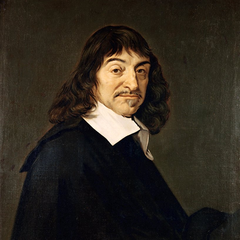 René Descartes1596–1650 · Mathematician & Philosopher“Divide each difficulty into as many parts as is feasible and necessary to resolve it.”
Divide the difficulty. A real power equals 1 in exactly three ways, and I take them in turn.
Case 1 — base = 1. x2 − 5x + 4 = 0, so (x−1)(x−4) = 0: x = 1, 4.
Case 2 — base = −1 with an even integer exponent. x2 − 5x + 6 = 0 gives x = 2, 3. At x = 2 the exponent is 4 − 18 + 20 = 6, even ✓. At x = 3 it is 9 − 27 + 20 = 2, even ✓.
Case 3 — exponent = 0 with a nonzero base. x2 − 9x + 20 = 0 gives x = 4, 5. The base at x = 4 is 1 ≠ 0, at x = 5 it is 5 ≠ 0 ✓.
Collecting without repetition: {1, 2, 3, 4, 5}. Their sum is 15.
x = 4 belongs to two cases at once; adding the cases instead of taking their union gives 19. And a base of 0 with exponent 0 would be undefined — worth the check, though it does not arise here.