AMC 8 Prep — Free Quiz
Quick Drill · 10 Questions · 20 min
20:00Exit
1
2
3
4
5
6
7
8
9
10
Question 1 of 10
Counting & ProbabilityMedium
How many different three-digit numbers can be formed using the digits 1, 2, 3, and 4 if no digit is repeated within a number?
A64
B24
C36
D12
E18
Explanation
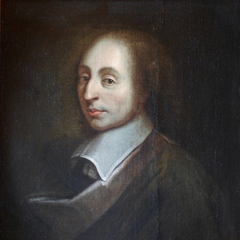
Blaise PascalBlaise Pascal1623–1662 · Co-founder of Probability“Chance has its own arithmetic; count every possibility fairly and it obeys.”
Build the number one place at a time and let the choices multiply — this is the counting principle at the root of all my work on chance. The hundreds place may take any of the 4 digits. Once it is spent, only 3 digits remain for the tens place, for we allow no repeats. Then just 2 remain for the units place. Because each first choice pairs with every second choice, and each of those with every third, the possibilities branch as a product: 4 · 3 · 2 = 24. Why we multiply, not add: addition would count separate options; multiplication counts combinations of independent decisions — and here each decision truly follows the last. See how “no repeats” quietly lowers the count at every step — 4, then 3, then 2. Grasp this branching, and the whole science of counting is yours.
Question 2 of 10
Multi-StepMedium
A shop first raises the price of a $40 item by 25%, and then takes 20% off the new, higher price. What is the final price?
A40
B38
C44
D42
E45
Explanation
Leonardo of Pisa (Fibonacci)Leonardo of Pisa (Fibonacci)c. 1170–1250 · Master of Practical Arithmetic“A merchant who mistakes his percentages loses his fortune; take each step on its own base.”
A merchant who believes “up 25%, then down 20%” means “up 5%” will one day lose his purse — for each percentage is taken of a different amount. Walk it step by step, each on its own base. First, raise $40 by 25%: the rise is 0.25 · 40 = $10, so the price becomes $50. Then take 20% off that $50: the cut is 0.20 · 50 = $10, leaving 50 − 10 = $40. Why it returns exactly to the start: raising by a quarter multiplies by 1.25, and cutting by a fifth multiplies by 0.80 — and 1.25 · 0.80 = 1, so the two changes perfectly undo each other. Always apply a percentage to the amount actually before you, never to the one you started with. Keep that discipline and your reckoning — in a shop or in a science — will always balance.
Question 3 of 10
AlgebraMedium
If x + 2y = 10 and 3xy = 9, what is the value of xy?
A5
B2
C3
D1
E4
Explanation
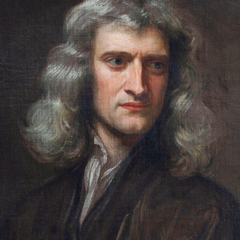
Isaac NewtonIsaac Newton1643–1727 · Mathematician & Physicist“If I have seen further, it is by standing on the shoulders of giants.”
Two equations, two unknowns — eliminate one and the rest follows. We have x + 2y = 10 and 3xy = 9. Double the second equation so the y terms can cancel with the first: 6x − 2y = 18. Add it to x + 2y = 10, and the y’s vanish: 7x = 28, so x = 4. Put x = 4 back into the first equation: 4 + 2y = 10, giving y = 3. Therefore xy = 4 − 3 = 1. Takeaway: to solve a pair of linear equations, scale one until a variable’s coefficients match, then add or subtract to make that variable disappear.
Question 4 of 10
Number TheoryMedium
How many positive integers less than 100 are divisible by both 6 and 9?
A5
B11
C7
D9
E3
Explanation
Hypatia of AlexandriaHypatia of Alexandriac. 350–415 · Mathematician & Astronomer“Reserve your right to think, for even to think wrongly is better than not to think at all.”
The word “both” is the whole puzzle. A number divisible by both 6 and 9 is not divisible by their product, but by their least common multiple — the smallest number both divide. Since 6 = 2 · 3 and 9 = 3 · 3, their least common multiple is 2 · 3 · 3 = 18 (we take the factor 3 only twice, not three times). Now count the multiples of 18 below 100: 18, 36, 54, 72, 90 — that is 5 numbers. Guard against two traps: the answer is not 100 ÷ 18 rounded loosely, and it is certainly not built from 6 · 9 = 54. Takeaway: “divisible by both” always means “divisible by the LCM” — find the LCM first, then simply count its multiples.
Question 5 of 10
GeometryMedium
A rectangle has area 60 and perimeter 34. What is the length of its diagonal?
A15
B14
C13
D17
E12
Explanation
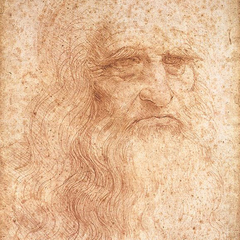
Leonardo da VinciLeonardo da Vinci1452–1519 · Polymath & Geometer“Let no one who is not a mathematician read the elements of my work.”
You need not find the two sides at all — one identity carries you straight to the diagonal. Let the sides be l and w. The perimeter gives l + w = 34 ÷ 2 = 17, and the area gives l · w = 60. The diagonal, by the Pythagorean theorem, is √(l² + w²). Now use the identity (l + w)² = l² + 2lw + w²: so l² + w² = (l + w)² − 2lw = 17² − 2 · 60 = 289 − 120 = 169. The diagonal is √169 = 13. Takeaway: when you know a sum and a product, the sum of squares comes free from (sum)² − 2·(product) — no need to solve for the pieces.
Question 6 of 10
Number TheoryMedium
How many whole numbers from 1 to 200 are a multiple of 3 or a multiple of 5?
A100
B90
C106
D80
E93
Explanation
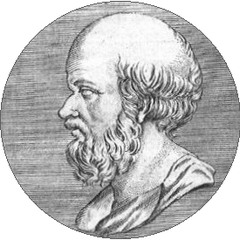
EratosthenesEratosthenesc. 276–194 BCE · Greek mathematician“To know the whole, first sort it into what overlaps and what does not.”
That little word “or” hides a trap that has fooled counters for centuries. If you simply add the multiples of 3 to the multiples of 5, every number that belongs to both lists — 15, 30, 45, and so on — is counted twice. My remedy is what today is called Inclusion–Exclusion: count each group, then subtract the shared part exactly once. Multiples of 3 up to 200: ⌊200 ÷ 3⌋ = 66. Multiples of 5: ⌊200 ÷ 5⌋ = 40. The numbers in both lists are the multiples of 15: ⌊200 ÷ 15⌋ = 13. So the true count is 66 + 40 − 13 = 93. Remember this: for “A or B,” always compute A + B − (both). Master that single correction and you will never miscount an overlap again — the same principle scales all the way up to the mathematics of the modern world.
Question 7 of 10
GeometryMedium Diagram
The midpoints of the four sides of a square with side length 10 are joined to form a smaller, tilted square (shaded). What is the area of the smaller square?
10
A50
B75
C100
D40
E25
Explanation
PythagorasPythagorasc. 570–495 BCE · Greek geometer“All is number; even a shape hides an arithmetic waiting to be found.”
A shape, you will find, always hides an arithmetic. Look at what the tilted square leaves behind: four identical right triangles in the corners, each with two short legs of 5 (half of a side of 10). Each corner triangle has area ½ · 5 · 5 = 12.5, and four of them together cover 4 · 12.5 = 50. The whole square measures 10 · 10 = 100, so the shaded square must be 100 − 50 = 50. The beautiful truth: joining the midpoints of any square yields an inner square with exactly half the area. (See it through my theorem as well: the tilted side is √(5² + 5²) = √50, so its square is 50.) When a figure resists you, count what surrounds it. The path around a problem is often shorter than the path through it — remember that, and geometry will open to you.
Question 8 of 10
Multi-StepMedium
Ana runs at 8 mph and Ben runs at 6 mph on a straight road, starting from the same point in the same direction. After Ana has run 4 miles, she stops and waits. How many minutes until Ben reaches her?
A10
B15
C30
D20
E5
Explanation
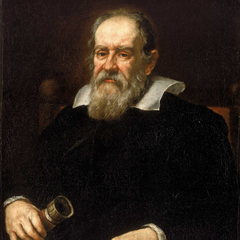
Galileo GalileiGalileo Galilei1564–1642 · Father of Modern Science“Measure what is measurable, and make measurable what is not so.”
Motion yields to measurement — track time and distance step by step. First, how long does Ana run? She covers 4 miles at 8 mph, taking 4 ÷ 8 = 0.5 hour = 30 minutes, then stops. In those same 30 minutes Ben, at 6 mph, has covered 6 · 0.5 = 3 miles — so when Ana stops, Ben is still 4 − 3 = 1 mile behind her. Ben now needs to cover that last mile at 6 mph: 1 ÷ 6 hour = 1/6 · 60 = 10 minutes. Takeaway: in motion problems, convert everything to a common measure of time, find the remaining gap, then divide the gap by the speed that closes it.
Question 9 of 10
AlgebraMedium
The average of five numbers is 18. When one of the numbers is removed, the average of the remaining four numbers is 20. What number was removed?
A4
B20
C10
D2
E16
Explanation
Muhammad al-KhwārizmīMuhammad al-Khwārizmīc. 780–850 · Father of Algebra“Restore and balance, and what is unknown becomes known.”
Do not chase the five unknown numbers — you do not need them. The heart of every average is a single idea: an average is only a total shared out evenly, so total = average × count. Restore each average to its total and balance the two. Five numbers averaging 18 hold a total of 5 · 18 = 90. After one departs, four numbers averaging 20 hold 4 · 20 = 80. The number that left carried away exactly the difference: 90 − 80 = 10. A check that also teaches: removing a number below the old average should pull the average up — and indeed 10 sits below 18, and the average rose from 18 to 20. Turn averages into totals and the fog lifts every time. This is the very act of restoring and balancing from which algebra takes its name — and you just performed it.
Question 10 of 10
Counting & ProbabilityMedium
In how many ways can 4 different books be arranged on a shelf so that the red book is next to the blue book?
A6
B12
C8
D16
E24
Explanation
Ada LovelaceAda Lovelace1815–1852 · First Computer Programmer“The Analytical Engine weaves algebraic patterns, just as the loom weaves flowers.”
When two things must stay together, bind them into a single package and count in two stages. Glue the red and blue books into one block; that block, together with the other 2 books, makes 3 items to arrange in a row. Three items can be ordered in 3! = 3 · 2 · 1 = 6 ways. But inside the block the red and blue books can themselves be ordered 2 ways (red–blue or blue–red). Multiply the two independent stages: 6 · 2 = 12. Takeaway: for “must be adjacent,” treat the pair as one unit, arrange everything, then multiply by the internal arrangements of the unit.

Score
Correct
Wrong
Try Again Exit