World History · Semester B TEKS 1D-14C
HardImage
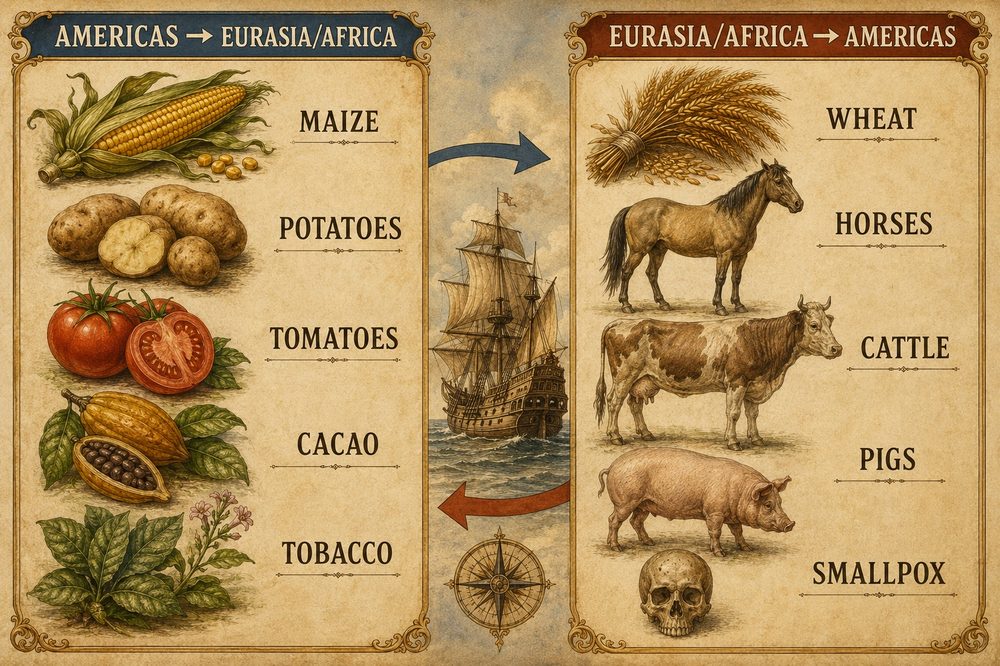
The COLUMBIAN EXCHANGE (post-1492 transfer of crops, animals, diseases, and human populations across the Atlantic) had which SPECIFIC BIOLOGICAL and DEMOGRAPHIC EFFECTS?
AConfined to a single generation and substantially reversed by later regimes, with no lasting institutional legacy and no direct influence on the developments that followed in subsequent centuries.
BAmerican crops (potatoes, maize, tomatoes, cassava, chili peppers, cacao, tobacco) transformed Afro-Eurasian agriculture and diet; Afro-Eurasian crops (wheat, rice, sugar cane) and livestock (cattle.
CWidely rejected in modern historical scholarship as an inaccurate 19th-century reconstruction of a much more limited underlying event, with little primary-source basis.
DPrimarily a modern reinterpretation of a much older and geographically distinct tradition, with the modern framing bearing little resemblance to what participants would have recognized in their own period.
Explanation
The Columbian Exchange had specific biological and demographic effects. American crops transformed Afro-Eurasian agriculture and diet — potatoes became European staples (Ireland particularly), maize spread across Africa (with substantial roles in Southern and Eastern African food systems) and Asia, tomatoes reshaped Mediterranean cuisines, cassava became staple across tropical Africa, chili peppers reshaped cuisines from Sichuan to Kerala to Ethiopia, cacao became global commodity, tobacco became global smoking commodity. Afro-Eurasian crops and livestock transformed American landscapes — wheat, rice, sugar cane became American colonial commodity crops, cattle transformed North American plains and Pampas, pigs became widespread free-range presence, sheep supported Andean and various other pastoral economies, horses were adopted by North American Plains peoples transforming their societies. Afro-Eurasian diseases produced catastrophic mortality among indigenous Americans — with smallpox, measles, influenza, typhus, and various other diseases producing estimated 50–90% mortality over subsequent centuries in previously-unexposed populations lacking any immunity. Transatlantic slave trade moved approximately 12 million Africans to the Americas across the 16th–19th centuries — reshaping African, American, and global demographics with substantial continuing legacies. Alfred Crosby's 1972 Columbian Exchange remains foundational analytical framework.
¿Listo para empezar a practicar?
Free sample questions available. No credit card required.
More World History practice
Image · TEKS 1D-14C
The AGE of EXPLORATION (roughly 15th–16th centuries) was DRIVEN by which BROAD FACTORS?
Image · TEKS 1D-14C
The HOLOCAUST during WORLD WAR II involved the systematic murder of approximately how many EUROPEAN JEWS by Nazi Germany?
Image · TEKS 15A-15C
The GREAT WALL of CHINA was built primarily for what purpose?
Image · TEKS 1A-4J
The FALL of the WESTERN ROMAN EMPIRE is traditionally dated to which year?