World History · Semester B TEKS 1D-14C
MediumImage
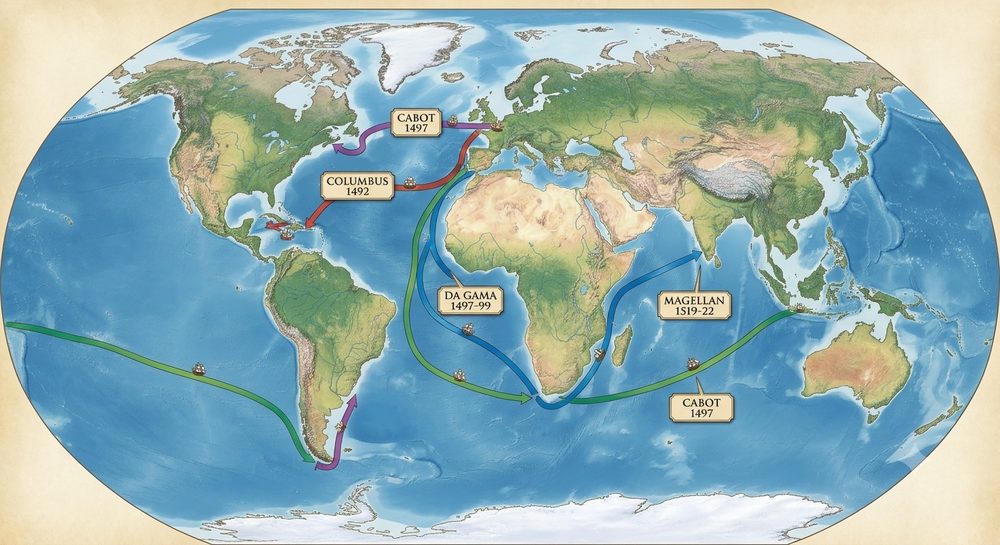
The AGE of EXPLORATION (roughly 15th–16th centuries) was DRIVEN by which BROAD FACTORS?
AA minor regional development that had no lasting influence on broader historical patterns and left no durable institutional or cultural legacy in the surrounding areas.
BEuropean desire to bypass Ottoman-controlled overland routes to Asia (following 1453 fall of Constantinople); technological improvements (caravel ship, compass, astrolabe); competitive rivalry.
CBest treated as an artifact of 19th-century nationalist historiography rather than as a distinctive historical development, with most substantive claims about it lacking primary-source support.
DPrimarily a modern reinterpretation of a much older and geographically distinct tradition, with the modern framing bearing little resemblance to what participants would have recognized in their own period.
Explanation
The Age of Exploration (roughly 15th–16th centuries with earlier Portuguese-Atlantic exploration starting ~1418 under Prince Henry the Navigator, Vasco da Gama's 1497–1499 voyage to India, Columbus's 1492 Atlantic crossing, Magellan expedition 1519–1522 first circumnavigation) was driven by broad factors. European desire to bypass Ottoman-controlled overland routes to Asia (following 1453 fall of Constantinople which put substantial control of eastern Mediterranean trade routes in Ottoman hands, motivating alternative route-finding). Technological improvements — caravel ship (Portuguese combination of lateen and square rigging providing greater maneuverability), improved compass and astrolabe navigation, improved cartography drawing on Islamic and classical precedents. Competitive rivalry between Portugal and Spain (with Papal division at Treaty of Tordesillas 1494 drawing a north-south meridian dividing new-world claims — Portuguese gaining Brazil, Africa, and Asian trade; Spanish gaining most of Americas). Religious motivations — spreading Christianity (with substantial missionary programs), opposing Islamic power (with fifteenth-century Reconquista completion feeding into subsequent overseas activity). Commercial opportunities — spice trade profits particularly (pepper, cinnamon, cloves, nutmeg being extremely valuable Asian imports) drove much investment in exploration and eventual colonial control.
¿Listo para empezar a practicar?
Free sample questions available. No credit card required.
More World History practice
Image · TEKS 1D-14C
The COLUMBIAN EXCHANGE (post-1492 transfer of crops, animals, diseases, and human populations across the Atlantic)...
Image · TEKS 1D-14C
The HOLOCAUST during WORLD WAR II involved the systematic murder of approximately how many EUROPEAN JEWS by Nazi Germany?
Image · TEKS 15A-15C
The GREAT WALL of CHINA was built primarily for what purpose?
Image · TEKS 1A-4J
The FALL of the WESTERN ROMAN EMPIRE is traditionally dated to which year?