Question 1 of 10
The Renaissance (14th–17th centuries CE), beginning in northern Italian city-states, is BEST characterized by:
AChronologically misplaced in most popular accounts, occurring substantially earlier or later than commonly claimed.
BRenewed European interest in classical Greek and Roman culture and scholarship, alongside advances in art, science, and humanist thought that reshaped European intellectual life.
CLeft almost no documentary or archaeological trace, with surviving accounts consisting largely of later legendary material.
DA total rejection of any classical influence on European culture.
Explanation
The Renaissance was a period of renewed European interest in classical Greek and Roman culture and scholarship, alongside major advances in art (Michelangelo, Leonardo), science (early empirical inquiry that fed into the Scientific Revolution), and humanist thought (Erasmus, Petrarch). It began in northern Italian city-states (Florence, Venice, Rome) in the 14th century and spread across Europe over the following centuries. Options B–D contradict documented history.
Question 2 of 10
The Protestant Reformation, beginning with Martin Luther's 95 Theses in 1517, had which of the following religious and political consequences?
AIt had no measurable effect on European religion or politics.
BIt unified all European Christians into a single denomination.
CIt permanently divided Western European Christianity into Roman Catholic and multiple Protestant traditions, triggered religious wars (including the Thirty Years' War), and reshaped the political map.
DBest understood as a legendary elaboration by later chroniclers rather than as a documented historical event, with the actual underlying circumstances being far more modest.
Explanation
The Protestant Reformation (Luther's 95 Theses, 1517; extended through Calvin, Zwingli, and others) permanently divided Western European Christianity into Roman Catholic and multiple Protestant traditions (Lutheran, Reformed, Anglican, Baptist, and others), triggered religious wars including the Thirty Years' War (1618–1648), and reshaped the political map of Central Europe (the 1648 Peace of Westphalia). Options B–D contradict documented history.
Question 3 of 10
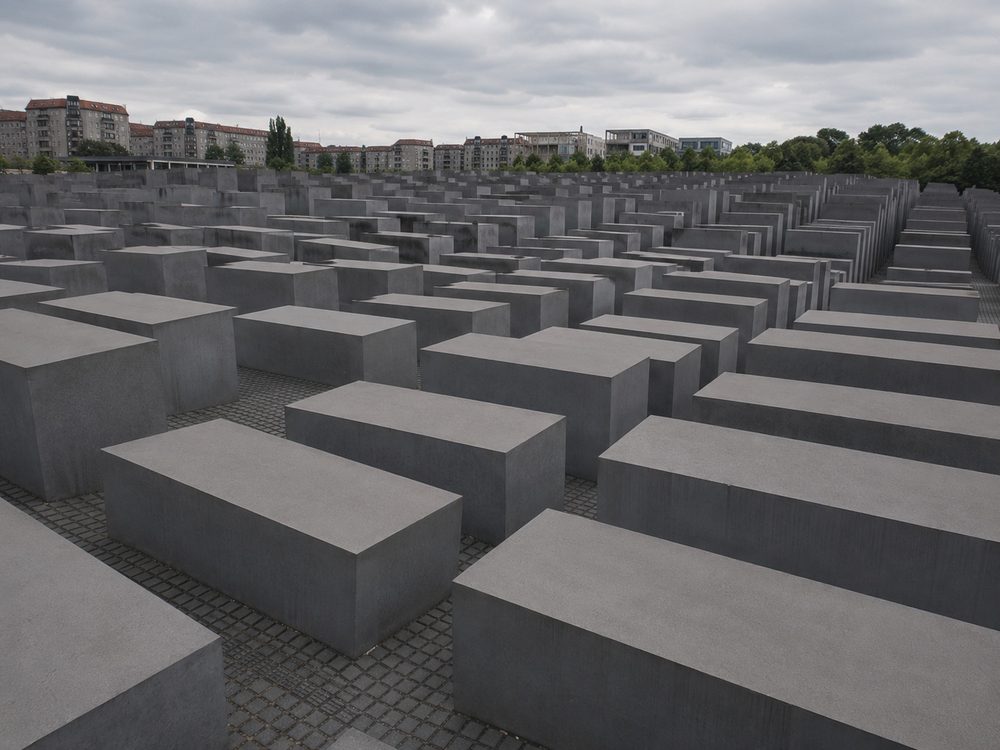
The HOLOCAUST during WORLD WAR II involved the systematic murder of approximately how many EUROPEAN JEWS by Nazi Germany?
AApproximately 50,000 total European Jewish victims.
BApproximately 100 billion victims — a claim not supported by any records.
CApproximately 6 million.
DApproximately 500 total victims across the entire war.
Explanation
The Holocaust during World War II (1941–1945) involved the systematic murder of approximately 6 million European Jews by Nazi Germany and its collaborators. This was carried out through mass shootings by Einsatzgruppen (particularly in occupied Soviet territories from 1941 onward), extermination camps with gas chambers (Auschwitz-Birkenau, Treblinka, Sobibor, Belzec, Chelmno, Majdanek), death marches, starvation and mistreatment in ghettos and concentration camps, and various other means. The Holocaust also targeted and killed millions of other victims — Roma/Sinti, Soviet POWs, Polish civilians, gay men, people with disabilities, political prisoners, Jehovah's Witnesses, and others. Total mortality from Nazi persecution across all groups is estimated at approximately 11 million people. The Holocaust is one of the most extensively-documented genocides in history and has substantially shaped subsequent international law (Genocide Convention 1948), Holocaust memory (Yad Vashem in Israel, US Holocaust Memorial Museum in Washington, and many others), and ongoing scholarly and public engagement.
Question 4 of 10
The SCIENTIFIC REVOLUTION (roughly 16th–17th centuries CE) transformed European intellectual life by:
AWidely rejected in modern historical scholarship as an inaccurate 19th-century reconstruction of a much more limited underlying event, with little primary-source basis.
BChronologically misplaced in most popular accounts, occurring substantially earlier or later than commonly claimed, and involving different actors from those usually named.
CReplacing much of medieval Aristotelian and Ptolemaic natural philosophy with empirical, mathematical approaches — canonical figures include Copernicus, Galileo, Kepler, and Newton.
DConfined to a single generation and substantially reversed by later regimes, with no lasting institutional legacy and no direct influence on the developments that followed in subsequent centuries.
Explanation
The Scientific Revolution (16th–17th centuries CE) replaced much of medieval Aristotelian and Ptolemaic natural philosophy with empirical, mathematical approaches. Canonical figures: Copernicus (heliocentric solar system), Galileo (telescope, mechanics), Kepler (planetary motion), Newton (universal gravitation, mathematical principles of natural philosophy). It laid the intellectual foundation for later Enlightenment thought and modern natural science.
Question 5 of 10
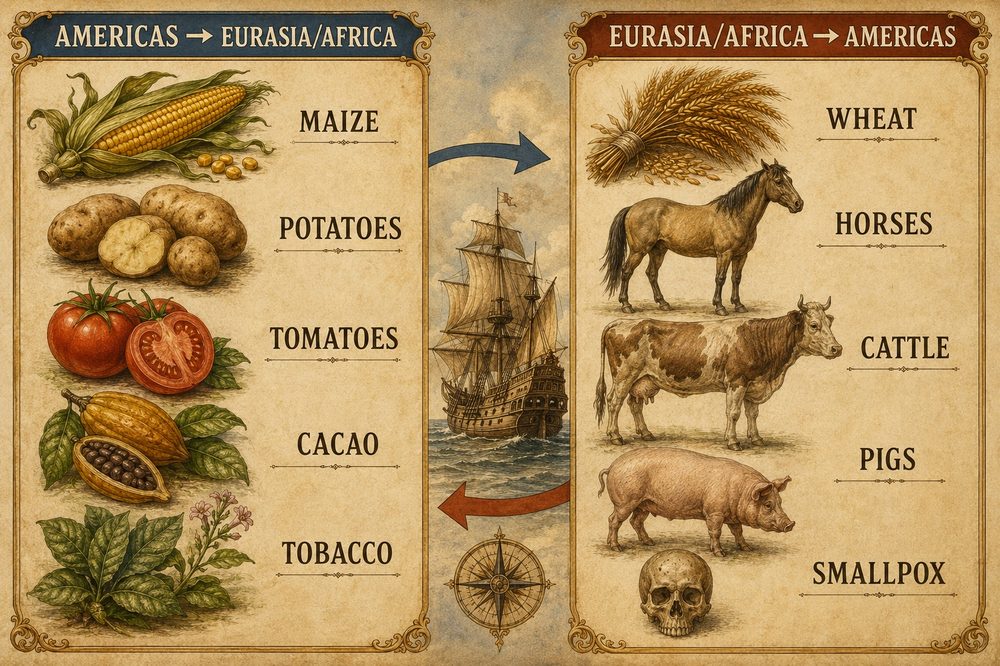
The COLUMBIAN EXCHANGE (post-1492 transfer of crops, animals, diseases, and human populations across the Atlantic) had which SPECIFIC BIOLOGICAL and DEMOGRAPHIC EFFECTS?
APrimarily a modern reinterpretation of a much older and geographically distinct tradition, with the modern framing bearing little resemblance to what participants would have recognized in their own period.
BAmerican crops (potatoes, maize, tomatoes, cassava, chili peppers, cacao, tobacco) transformed Afro-Eurasian agriculture and diet; Afro-Eurasian crops (wheat, rice, sugar cane) and livestock (cattle.
CConfined to a single generation and substantially reversed by later regimes, with no lasting institutional legacy and no direct influence on the developments that followed in subsequent centuries.
DWidely rejected in modern historical scholarship as an inaccurate 19th-century reconstruction of a much more limited underlying event, with little primary-source basis.
Explanation
The Columbian Exchange had specific biological and demographic effects. American crops transformed Afro-Eurasian agriculture and diet — potatoes became European staples (Ireland particularly), maize spread across Africa (with substantial roles in Southern and Eastern African food systems) and Asia, tomatoes reshaped Mediterranean cuisines, cassava became staple across tropical Africa, chili peppers reshaped cuisines from Sichuan to Kerala to Ethiopia, cacao became global commodity, tobacco became global smoking commodity. Afro-Eurasian crops and livestock transformed American landscapes — wheat, rice, sugar cane became American colonial commodity crops, cattle transformed North American plains and Pampas, pigs became widespread free-range presence, sheep supported Andean and various other pastoral economies, horses were adopted by North American Plains peoples transforming their societies. Afro-Eurasian diseases produced catastrophic mortality among indigenous Americans — with smallpox, measles, influenza, typhus, and various other diseases producing estimated 50–90% mortality over subsequent centuries in previously-unexposed populations lacking any immunity. Transatlantic slave trade moved approximately 12 million Africans to the Americas across the 16th–19th centuries — reshaping African, American, and global demographics with substantial continuing legacies. Alfred Crosby's 1972 Columbian Exchange remains foundational analytical framework.
Question 6 of 10
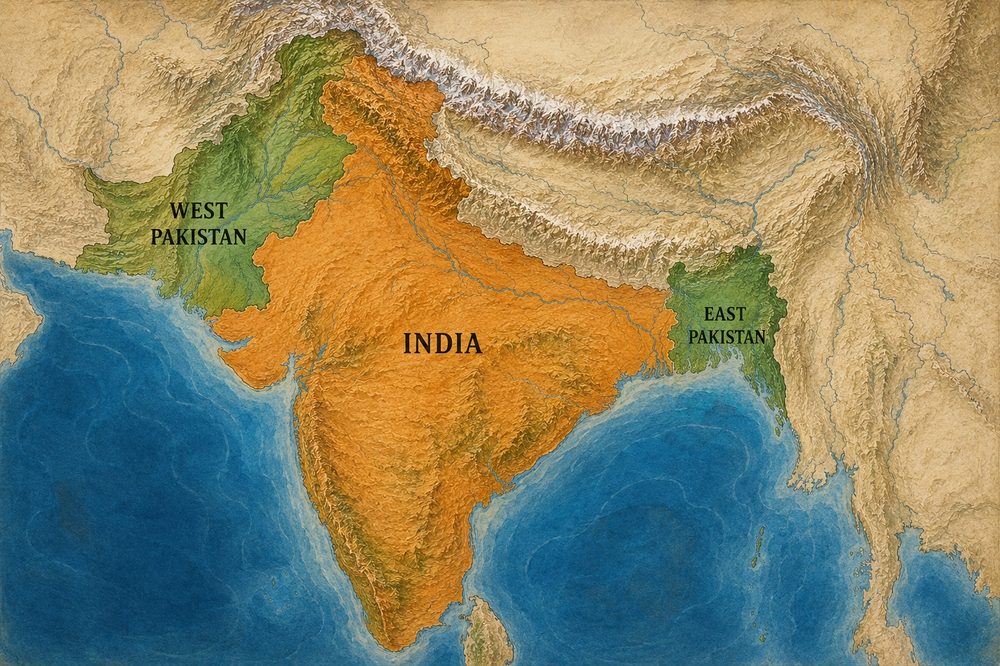
The INDEPENDENCE of INDIA and PAKISTAN (August 1947) had which specific features?
APrimarily military in character, with little cultural or institutional influence beyond the immediate battlefield context, and no lasting effect on subsequent regional political arrangements.
BLeft almost no documentary or archaeological trace in its own period, with surviving accounts consisting largely of later legendary material composed centuries after the supposed events.
CBritish withdrawal from India led to partition of British India into India (Hindu-majority) and Pakistan (Muslim-majority, initially with East and West wings on either side of India); massive.
DPrimarily a modern reinterpretation of a much older and geographically distinct tradition, with the modern framing bearing little resemblance to what participants would have recognized in their own period.
Explanation
The independence of India and Pakistan (August 15, 1947 for India; August 14, 1947 for Pakistan) had specific features. British withdrawal from India led to partition of British India into India (Hindu-majority though secular in constitutional design under Nehru) and Pakistan (Muslim-majority under Muhammad Ali Jinnah, initially with East and West wings on either side of India — East Pakistan later becoming Bangladesh in 1971). Massive population movements followed — roughly 14 million people crossed the new borders (Hindus and Sikhs moving east into India, Muslims moving west into Pakistan) in one of the largest migrations in human history. Communal violence killed several hundred thousand to over a million people during and after Partition. And unresolved disputes (particularly over Kashmir, which triggered the first Indo-Pakistani War 1947–1948 and remains contested today) shaped subsequent South Asian conflicts (further Indo-Pakistani Wars 1965, 1971, and Kargil 1999).
Question 7 of 10
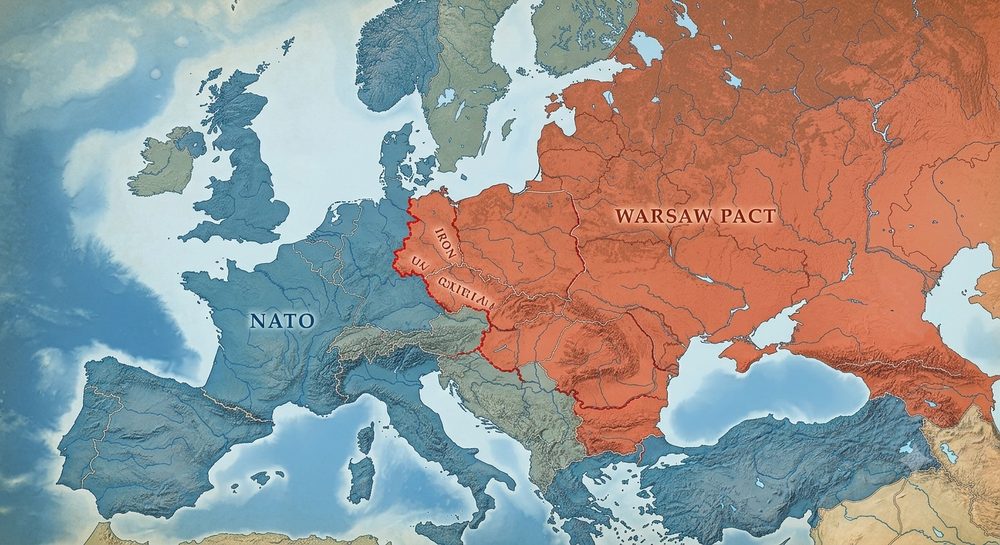
The GEOGRAPHIC CONSEQUENCES of the COLD WAR included which specific arrangements?
AA minor regional development that had no lasting influence on broader historical patterns and left no durable institutional or cultural legacy in the surrounding areas.
BThe division of Germany into West and East (1949–1990); the Iron Curtain across Central Europe; the division of Korea at the 38th parallel (from 1948, and maintained after the Korean War 1950–1953.
CChronologically misplaced in most popular accounts, occurring substantially earlier or later than commonly claimed, and involving different actors from those usually named.
DWidely discussed in older popular accounts but rarely referenced in modern comparative historical scholarship, and generally regarded today as a minor rather than transformative episode in the broader historical trajectory.
Explanation
The Cold War produced specific geographic arrangements. Germany was divided into West (Federal Republic of Germany) and East (German Democratic Republic) from 1949 to 1990, with West Berlin as an isolated Western outpost inside East Germany surrounded by the Berlin Wall (1961–1989). The Iron Curtain across Central Europe separated Warsaw Pact and NATO states. Korea was divided at the 38th parallel (from 1948, maintained after the Korean War 1950–1953 ceasefire though a formal peace treaty was never signed). Cuba's alignment with the USSR (from 1961) produced the 1962 Cuban Missile Crisis and continuing tensions. Other alignments (Vietnam War, various proxy conflicts) produced hardened international borders and militarized geographies at multiple points around the world. These geographic arrangements shaped daily life for millions.
Question 8 of 10
The AGE OF EUROPEAN EXPLORATION (roughly 15th–17th centuries CE) was enabled by which combination of factors?
ARepresents a category confusion in most standard accounts, mixing distinct developments that occurred in different periods, regions, and cultural contexts under a single misleading label.
BChronologically misplaced in most popular accounts, occurring substantially earlier or later than commonly claimed, and involving different actors from those usually named.
CImprovements in ship design (caravel), navigation instruments (astrolabe, magnetic compass), cartography, and the search for direct maritime access to Asian spices and trade — bypassing overland.
DBest treated as an artifact of 19th-century nationalist historiography rather than as a distinctive historical development, with most substantive claims about it lacking primary-source support.
Explanation
The Age of European Exploration was enabled by a bundle of factors: technical (the caravel, astrolabe, magnetic compass, expanding cartographic knowledge), economic (search for direct maritime access to Asian spices and trade, bypassing overland routes controlled by the Ottoman Empire and others), political (competition between Portugal, Spain, and later Netherlands, England, France), and religious (missionary motivations). Portugal's coastal-Africa exploration in the 15th century led directly into Bartolomeu Dias reaching the Cape of Good Hope (1488) and Vasco da Gama reaching India (1498).
Question 9 of 10
The French Revolution (1789–1799) contributed which enduring political concepts to modern politics?
AAbsolute monarchy as the only legitimate form of government.
BPrimarily a modern reinterpretation of a much older and geographically distinct tradition, with the modern framing bearing little resemblance to what participants would have recognized in their own period.
CConfined to a narrow elite context, with limited broader social, economic, or cultural impact during the period.
DThe ideas of popular sovereignty, individual rights, secular government, and the possibility of overthrowing hereditary monarchy — codified in the 1789 Declaration of the Rights of Man and of the.
Explanation
The French Revolution (1789–1799) contributed enduring political concepts to modern politics: popular sovereignty (that political authority derives from the people), individual rights, secular government, and the possibility of overthrowing hereditary monarchy. The 1789 Declaration of the Rights of Man and of the Citizen codified many of these principles and influenced constitutional documents worldwide. Options B–D contradict documented history.
Question 10 of 10
The AGE of EXPLORATION (roughly 15th–16th centuries) was DRIVEN by which BROAD FACTORS?
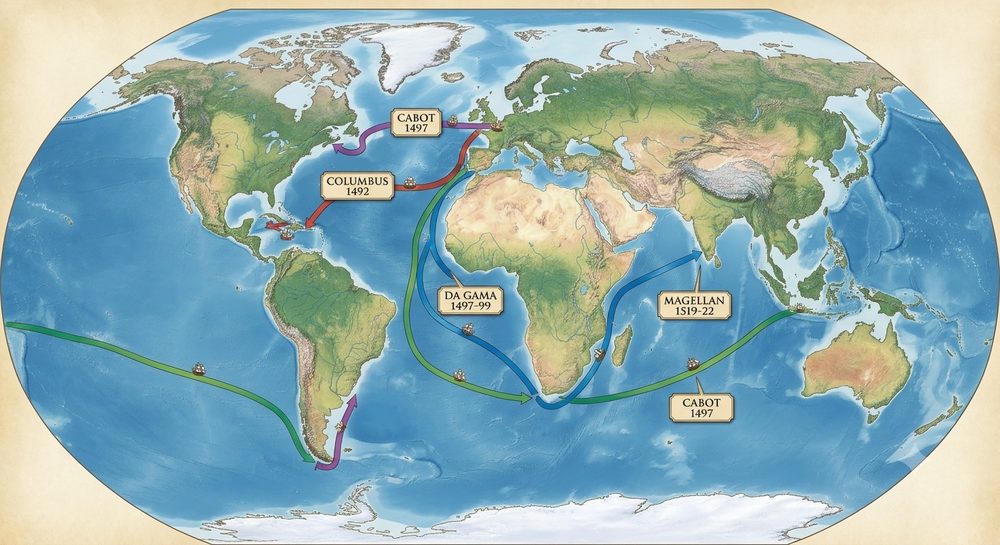
AEuropean desire to bypass Ottoman-controlled overland routes to Asia (following 1453 fall of Constantinople); technological improvements (caravel ship, compass, astrolabe); competitive rivalry.
BBest treated as an artifact of 19th-century nationalist historiography rather than as a distinctive historical development, with most substantive claims about it lacking primary-source support.
CA minor regional development that had no lasting influence on broader historical patterns and left no durable institutional or cultural legacy in the surrounding areas.
DPrimarily a modern reinterpretation of a much older and geographically distinct tradition, with the modern framing bearing little resemblance to what participants would have recognized in their own period.
Explanation
The Age of Exploration (roughly 15th–16th centuries with earlier Portuguese-Atlantic exploration starting ~1418 under Prince Henry the Navigator, Vasco da Gama's 1497–1499 voyage to India, Columbus's 1492 Atlantic crossing, Magellan expedition 1519–1522 first circumnavigation) was driven by broad factors. European desire to bypass Ottoman-controlled overland routes to Asia (following 1453 fall of Constantinople which put substantial control of eastern Mediterranean trade routes in Ottoman hands, motivating alternative route-finding). Technological improvements — caravel ship (Portuguese combination of lateen and square rigging providing greater maneuverability), improved compass and astrolabe navigation, improved cartography drawing on Islamic and classical precedents. Competitive rivalry between Portugal and Spain (with Papal division at Treaty of Tordesillas 1494 drawing a north-south meridian dividing new-world claims — Portuguese gaining Brazil, Africa, and Asian trade; Spanish gaining most of Americas). Religious motivations — spreading Christianity (with substantial missionary programs), opposing Islamic power (with fifteenth-century Reconquista completion feeding into subsequent overseas activity). Commercial opportunities — spice trade profits particularly (pepper, cinnamon, cloves, nutmeg being extremely valuable Asian imports) drove much investment in exploration and eventual colonial control.