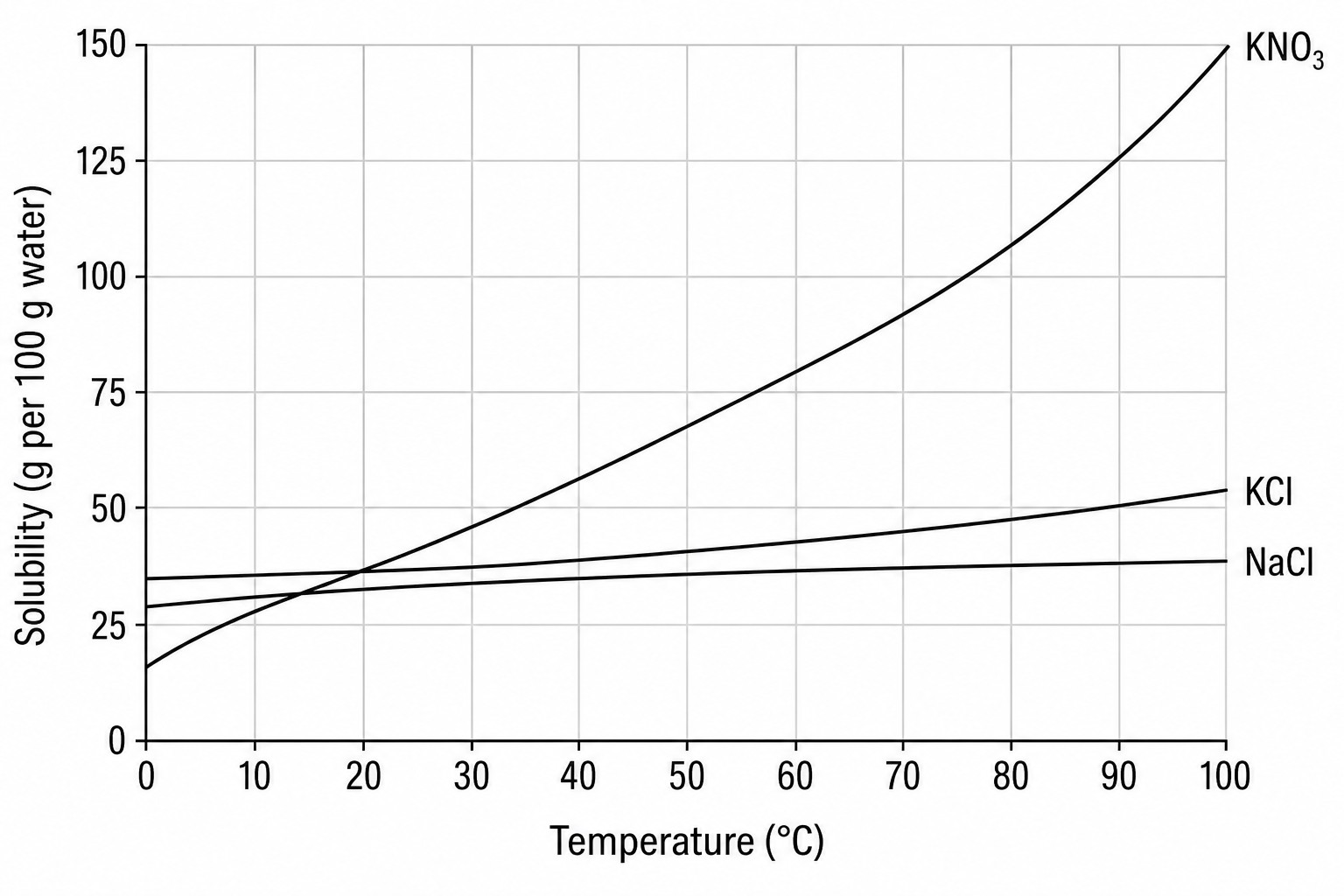
What is the molarity of a solution that contains 0.500 mol of NaCl dissolved in enough water to make 250 mL of solution?
A2.00 M
B0.500 M
C0.125 M
D125 M
Explanation
📌 Molarity (M) = moles of solute ÷ liters of solution = 0.500 mol ÷ 0.250 L = 2.00 M. Common error: forgetting to convert mL to L. 250 mL = 0.250 L. Molarity tells you concentration; don't confuse with molality (moles per kg solvent).
Question 2 of 10
TEKS 11A-11DMedium Calc Word
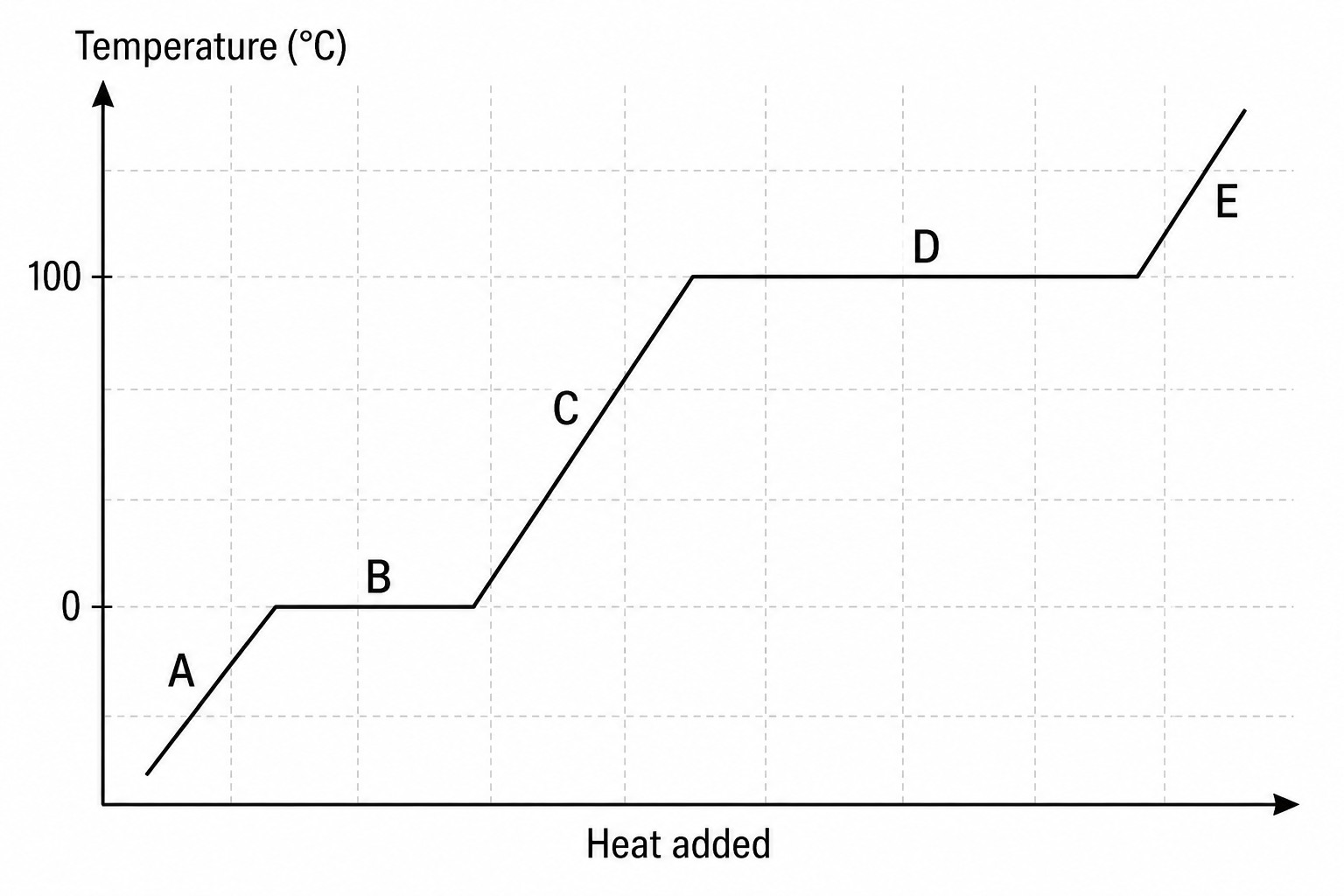
How much heat (in joules) is required to warm 50.0 g of water from 20.0 °C to 80.0 °C? (Specific heat of water = 4.18 J/(g·°C))
A3,344 J
B12,540 J
C8,360 J
D250.8 J
Explanation
📌 q = m × c × ΔT, where q is heat, m is mass, c is specific heat, and ΔT is temperature change. q = 50.0 g × 4.18 J/(g·°C) × (80.0 − 20.0) °C = 50.0 × 4.18 × 60.0 = 12,540 J. Always compute ΔT as final minus initial; positive ΔT means heat absorbed, negative means heat released.
Question 3 of 10
TEKS 12A-12CMedium Calc Word
Carbon-14 has a half-life of about 5,730 years. If a fossil sample initially contained 100. g of carbon-14, approximately how many grams remain after 17,190 years?
A6.25 g
B12.5 g
C50.0 g
D25.0 g
Explanation
📌 17,190 years ÷ 5,730 years per half-life = 3 half-lives. After each half-life, the remaining amount halves. So 100 g → 50 g (1st) → 25 g (2nd) → 12.5 g (3rd). General formula: remaining = initial × (1/2)ⁿ, where n is the number of half-lives elapsed. This is the basis of radiocarbon dating for fossils up to ~50,000 years old.
Question 4 of 10
TEKS 8A-8FMedium Calc Word
A student measures out 88.0 g of carbon dioxide (CO₂) for a stoichiometry experiment. How many moles of CO₂ does the sample contain? (Molar mass of CO₂ = 44.0 g/mol)
A3,872 mol
B2.00 mol
C1.00 mol
D0.500 mol
Explanation
📌 Moles = mass ÷ molar mass = 88.0 g ÷ 44.0 g/mol = 2.00 mol. The mole bridge: grams ↔ moles ↔ particles. To go from grams to moles, ALWAYS divide by molar mass. Multiplying (the common error in distractor D) gives an unreasonable answer.
Question 5 of 10
TEKS 10A-10DMedium Calc Word
A sealed flexible container holds 4.0 L of helium gas at 200. K and 1.0 atm. The container is warmed until the gas temperature reaches 400. K, while the pressure remains at 1.0 atm. What is the new volume of the gas?
A16 L
B8.0 L
C4.0 L
D2.0 L
Explanation
📌 Charles's Law (constant pressure): V₁/T₁ = V₂/T₂. Rearranging: V₂ = V₁ × (T₂/T₁) = 4.0 L × (400 K / 200 K) = 8.0 L. Doubling the absolute temperature (in Kelvin) doubles the volume at constant pressure. Always use Kelvin — converting from °C would give wildly wrong answers.
Question 6 of 10
TEKS 10A-10DEasy Word
Which statement about an ideal gas is TRUE according to the kinetic molecular theory?
AIdeal gas particles have significant volume
BIdeal gas particles slow down as temperature rises
CIdeal gas particles attract each other strongly
DIdeal gas particles move randomly and collide elastically
Explanation
📌 Kinetic Molecular Theory assumes ideal gas particles (1) have negligible volume relative to the container, (2) experience no intermolecular forces, (3) move in random straight-line motion, (4) undergo elastic collisions (no energy lost), and (5) have average kinetic energy proportional to absolute temperature. Real gases deviate at high pressure and low temperature.
Question 7 of 10
TEKS 8A-8FEasy Calc Word
How many moles of water are present in 36.0 g of H₂O? (Molar mass of H₂O = 18.0 g/mol)
A1.00 mol
B2.00 mol
C0.500 mol
D18.0 mol
Explanation
📌 Moles = mass ÷ molar mass = 36.0 g ÷ 18.0 g/mol = 2.00 mol. Repeat after me: grams → moles is ALWAYS division by molar mass. Multiplying produces an unreasonably huge answer (option D shows that error).
Question 8 of 10
TEKS 11A-11DEasy
When ammonium nitrate (NH₄NO₃) is dissolved in water inside a beaker, the temperature of the solution drops noticeably and the beaker feels cold to the touch. Based on this observation, the dissolution of NH₄NO₃ is best classified as:
AEndothermic
BExothermic
CCombustion
DNeutralization
Explanation
📌 When the surroundings (the beaker, your hand) get colder, the system absorbed heat from them → endothermic. The energy went INTO breaking apart the ionic lattice of NH₄NO₃ during dissolution. This is the principle behind instant cold packs — they use NH₄NO₃ dissolving in water for emergency cooling.
Question 9 of 10
TEKS 9A-9DEasy Calc Word
A water sample contains 5 mg of dissolved chloride ions per liter of solution. This concentration is equivalent to:
A5 ppm
B500 ppm
C0.5 ppm
D50 ppm
Explanation
📌 For dilute aqueous solutions (density ≈ 1 g/mL), parts per million ≈ mg per kg of solvent ≈ mg per liter. So 5 mg/L ≈ 5 ppm. Pattern: ppm = (mass of solute in g ÷ mass of solution in g) × 10⁶. Used for trace concentrations like water-quality testing (e.g., 'fluoride at 1 ppm in tap water').
Question 10 of 10
TEKS 12A-12CEasy Word
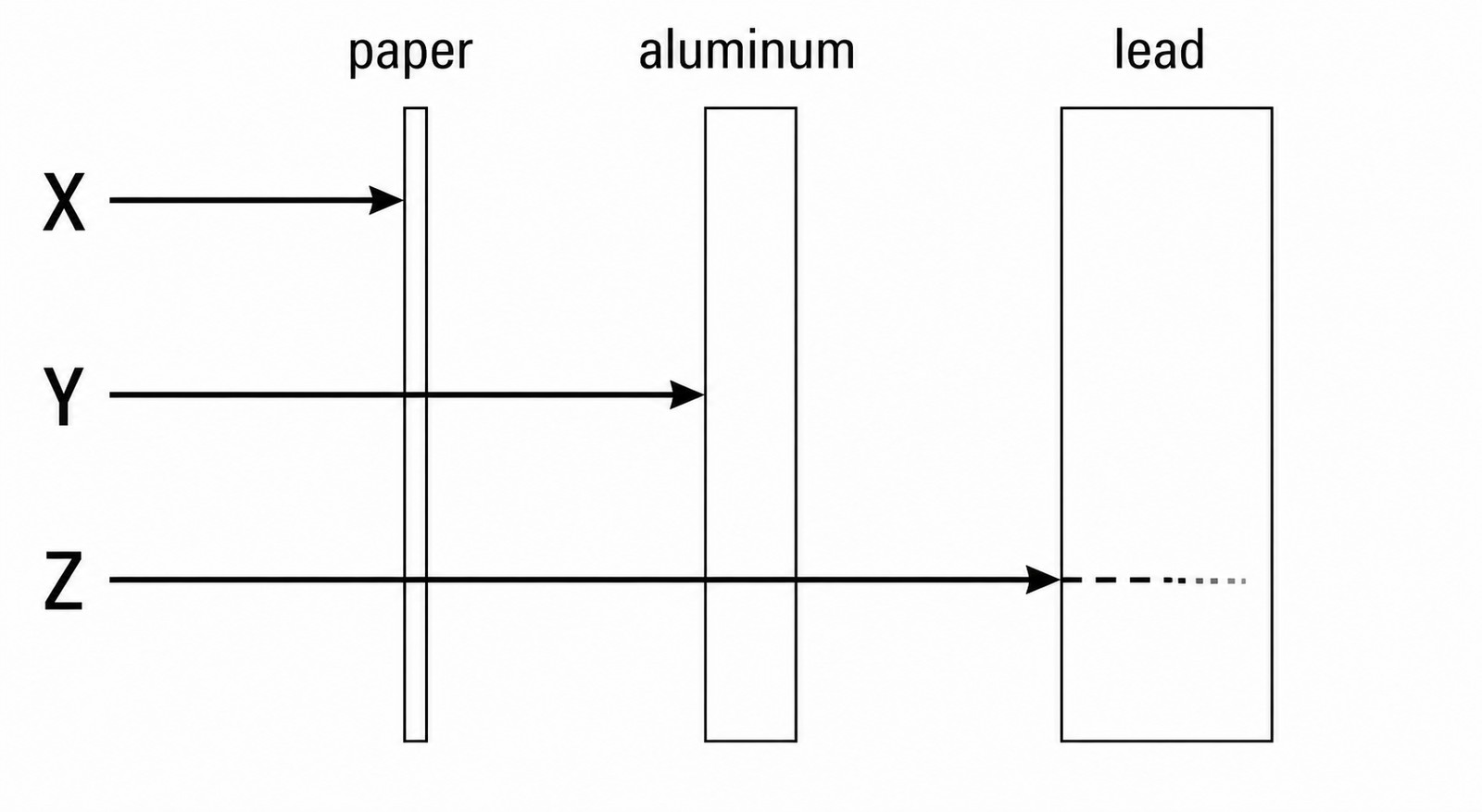
Which type of radioactive emission has NO mass and NO charge, consisting of high-energy electromagnetic radiation?
AGamma (γ) ray
BNeutron
CBeta (β) particle
DAlpha (α) particle
Explanation
📌 Gamma rays are pure electromagnetic radiation (like light, but much higher energy) — no mass, no charge. Alpha particles are helium nuclei (mass 4, charge +2). Beta particles are high-speed electrons (mass ~0, charge −1). Neutrons have mass 1 and no charge but are usually not classified with the three main decay types. Gamma rays often accompany alpha or beta decay as the nucleus releases excess energy.
Score
Correct
Wrong
Want unlimited practice?
Sign up free to track progress, get AI explanations, and access the full question bank.